Case file · Wealth management / FinTech

Aster Private Wealth

From complex portfolio models to clear client decisions.

Independent concept
Role
Product Designer
Focus
Private wealth management
Scope
Product strategy · IA · Interaction design · Prototyping
Tools
Figma · Claude Design
Advisor complexity
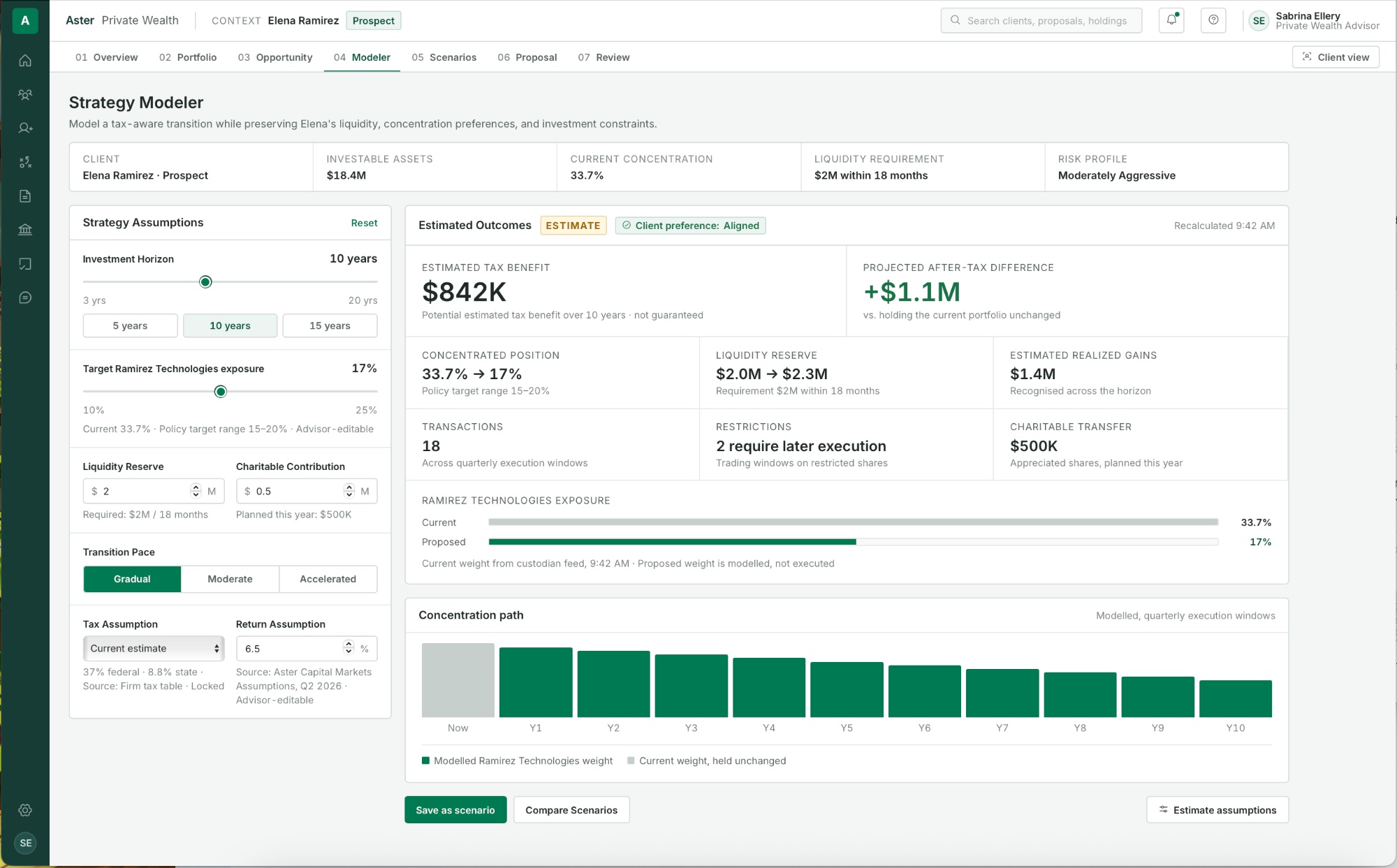
04 Modeler
Strategy Modeler with assumptions on the left and estimated outcomes on the right
Same financial decision.
Different information needs.
Client clarity
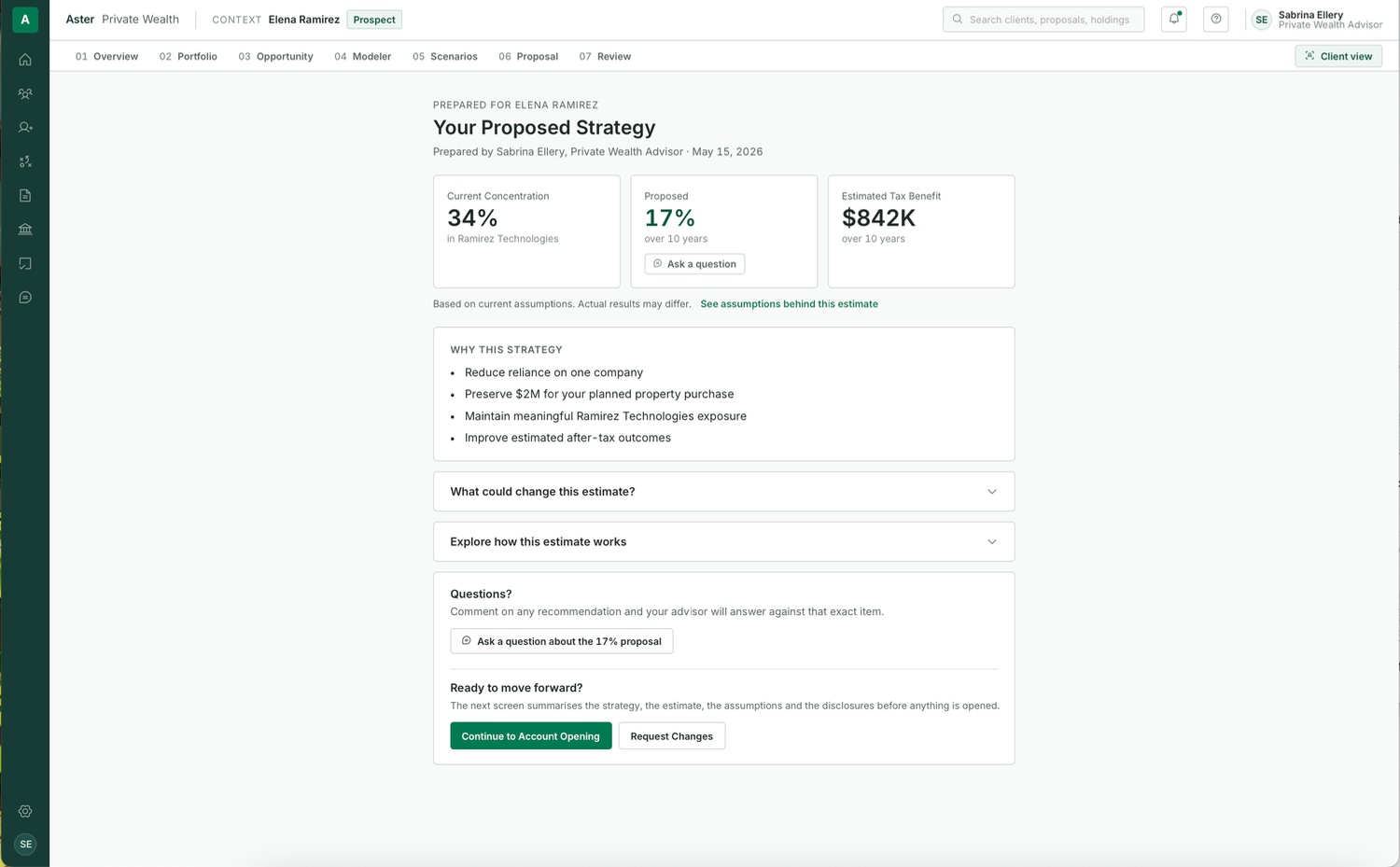
Client view
Client view showing current and proposed concentration and the estimated tax benefit
Synthetic financial data throughout
The problem
How do you explain a sophisticated financial strategy without oversimplifying it?
01 · The problem

I was helping my mother make sense of wealth management when I realized how difficult these workflows are to follow.

I kept having to work backward from financial terms and recommendations just to understand what was actually being proposed. The strategies themselves were not the hard part. Following how portfolio information turned into a recommendation, and eventually into a decision she had to make, was.

That became the question behind Aster: how could the workflow make that reasoning easier to follow without stripping away the financial detail the advisor still needs?

Financial complexity
  • Tax
  • Liquidity
  • Risk
  • Portfolio concentration
  • Restrictions
  • Investment assumptions
  • Client preferences
Client decision
  • What are you recommending?
  • Why?
  • What does this estimate mean?
  • What could change it?
  • What am I agreeing to?
A client is answering the second list. The advisor is working in the first.
To see where those two lists come apart, I started with the people involved in the recommendation.
02 · Who makes the decision

Before designing the interface, I mapped the people behind the decision.

Primary user

Private Wealth Advisor

Understands the client, explores strategies, works with specialists, and owns the recommendation.

Decision maker

Client / Prospect

Provides goals and constraints, asks questions, and decides whether to move forward.

Expertise

Portfolio Specialist

Provides deeper portfolio and strategy expertise.

Execution

Operations

Handles restrictions, funding, execution requirements, and account logistics.

Supervision

Compliance

Reviews disclosures, policy requirements, and supervision.

This made the advisor my primary user, while the other four roles shaped what the advisor needed to see and when.

03 · How wealth management moves

The recommendation is only one moment in a longer relationship.

Prospect→Understand client→Understand portfolio→Identify opportunity→Model strategy01 Estimate→Compare tradeoffs02 Tradeoffs→Explain recommendation03 Translation→Review→Client decision→Account opening

I mapped the relationship from prospecting through account opening to see where the recommendation actually sits. The advisor carries the same client information through every stage even though the task changes, which pushed me away from a set of disconnected pages and toward one connected flow. I focused Aster on the three stages above.

04 · Adjacent finance research

I also spoke with investment professionals in adjacent finance roles.

I used those conversations to pressure test a few assumptions about how high stakes financial work handles information, review, and AI.

01

As analysis grows, the important assumptions get harder to keep track of.

Shaped 01 Estimate →
02

When comparing alternatives, the critical financial variables need to stay visible together.

Shaped 02 Tradeoffs →
03

AI was seen as useful for gathering, cleaning, structuring, and drafting. Final judgment stayed human.

Shaped 03 Translation →
AI
Gather · Structure · Draft
Human
Evaluate · Decide · Approve

These ideas helped me sharpen several interaction decisions in Aster, but I did not use the interviews as validation of private wealth workflows.

05 · The key insight

Once I mapped the workflow, the design problem got more specific.

The advisor needs enough detail to build and defend a recommendation. The client needs enough to understand what is changing, why, and what could affect the estimate.

That distinction shaped how I designed Aster.
06 · The product strategy

I designed one decision flow instead of another financial dashboard.

I organized Aster around the main stages of the recommendation instead of around separate tools.

Primary client journey
01 Overview
Understand Elena
02 Portfolio
Understand what she owns
03 Opportunity
Identify potential value
04 Modeler
Test assumptions
05 Scenarios
Compare tradeoffs
06 Proposal
Construct the explanation
07 Review
Verify the recommendation
Scroll the journey →
Client accepts
Client decision
Client View
Understand and decide. A mode of the approved proposal, not step 08.
Next lifecycle state
Account Opening
Act on the approved decision.

The same client information moves through all nine stages instead of being re-entered at each one.

The interface changes.
The client context does not.
Supporting system

What holds the flow together.

01
Design decision

A financial estimate should explain itself.

Explainability · Provenance

The Modeler is where I spent the most time. If an advisor shortens the investment horizon and the projected benefit falls from $842K to $417K, updating the number is not enough on its own.

Aster · Strategy ModelerClick for controls
Changing an assumption recalculates the estimate and names the assumption that moved it.
Inputs
  • Investment horizon
  • Target exposure
  • Liquidity reserve
  • Charitable contribution
  • Transition pace
  • Return assumption
Outputs
  • Estimated tax benefit
  • After tax difference
  • Realized gains
  • Liquidity
  • Restrictions
  • Concentration path
The hero interaction
10 years→5 years
$842K→$417K
A shorter horizon gives the strategy less time to compound the modeled benefit.

I added a "Why did this change?" state so the advisor can connect the new result back to the assumption that caused it. Sources, timestamps, and whether a value is advisor editable or firm controlled all stay in the same workspace.

System anatomy
04 Modeler
Strategy Modeler: strategy assumptions on the left, estimated outcomes and concentration path on the right
Assumptions and outcomes remain visible in the same decision surface.
  1. 1
    Estimate label
    An explicit ESTIMATE badge and a recalculated timestamp.
  2. 2
    Where the number came from
    Current weight is from the custodian feed at 9:42 AM. Proposed weight is modelled, not executed.
  3. 3
    Editable or firm controlled
    The firm tax table is locked. The 6.5% return assumption is advisor editable and says so.
  4. 4
    Client preference state
    Elena's 15% floor is checked here in the Modeler rather than at approval.
02
Design decision

The highest number is not necessarily the best strategy.

Constraints · Tradeoffs

I first thought about the model mostly in terms of financial outcomes. But Elena's preferences and liquidity needs can make a stronger looking number a worse fit.

When the advisor models a 10% allocation to Ramirez Technologies, Aster surfaces that Elena previously said she wanted to keep at least 15%.

Target exposure
17%→10%

I originally treated preferences like something to check during review. That felt too late, so I moved the warning into the Modeler, where the allocation is actually being changed. The advisor can keep exploring, and the conflict and its source stay visible.

Client preference conflict

Elena indicated she wants to retain at least 15% exposure.

Source: planning meeting · May 14, 2026

Comparing scenarios on one screen.

The comparison view keeps tax benefit, concentration, realized gains, liquidity, transactions, restrictions, and client preference alignment together, so the advisor is weighing the full tradeoff instead of picking whichever scenario shows the largest projected benefit.

ComparisonGradual transitionAccelerated diversification
Estimated tax benefit$842K$1.06M
Company concentration33.7% → 17%33.7% → 9%
Realized gains$1.4M$3.2M
Liquidity$2.0M → $2.3M$2.0M → $4.1M
Transactions1841
Trading restrictions2 require later execution7 require later execution
Client preference alignmentAlignedBelow stated floor
A better financial outcome can still be the wrong client outcome.
Comparison figures are synthetic and illustrative.
03
Design decision

The advisor and client should not see the same interface.

Progressive disclosure

The advisor view carries the assumptions, sources, rationale, review status, and controls needed to build the proposal. I did not think Elena needed all of that at once.

Aster · Proposal builder to Client ViewClick for controls
Switching to Client View from the proposal builder.
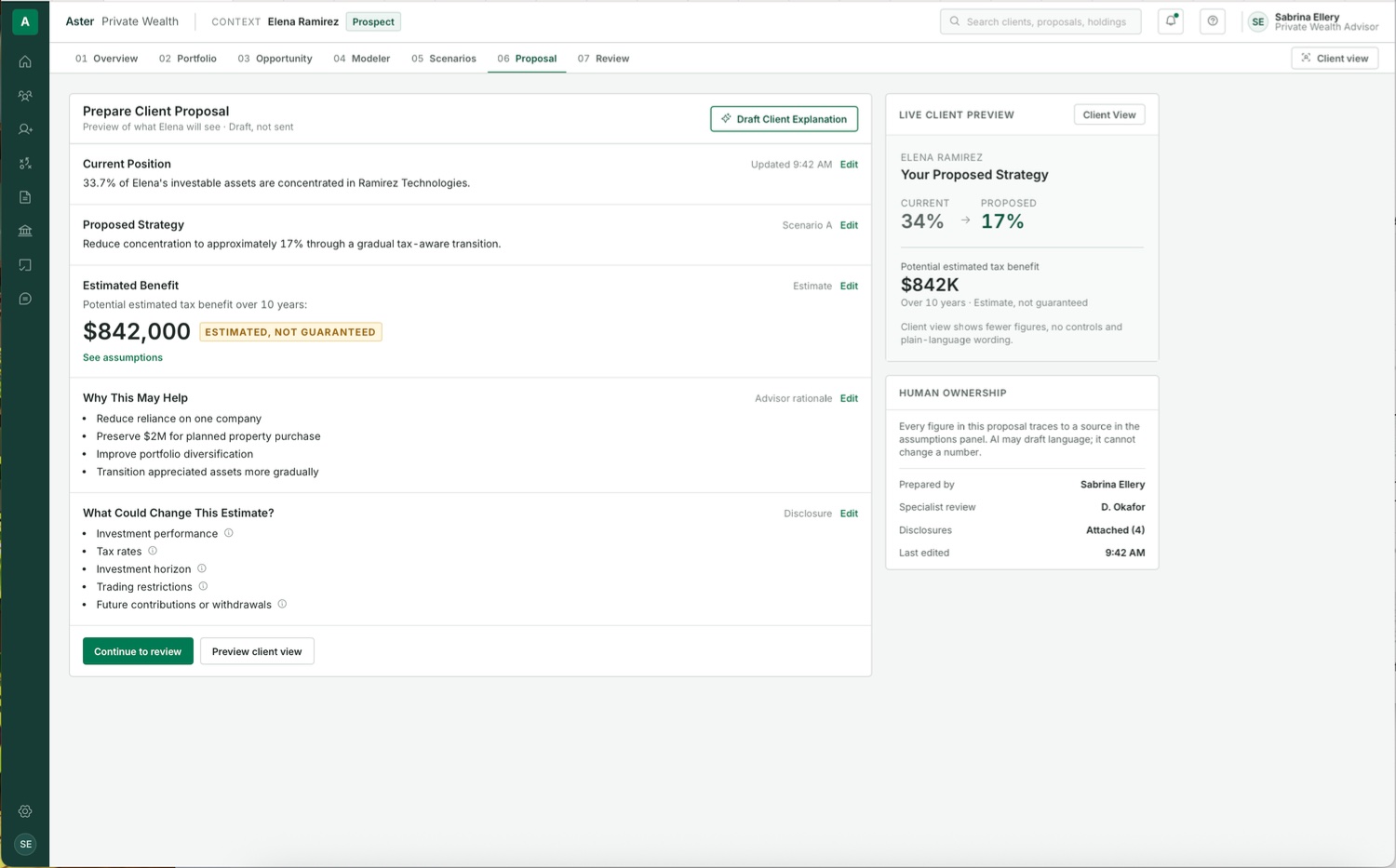
Advisor view
06 Proposal
Advisor proposal builder: current position, proposed strategy, estimated benefit, why this may help, what could change the estimate, live client preview and human ownership
Current position, proposed strategy, estimated benefit, assumptions, risks, sources, rationale, and review ownership.
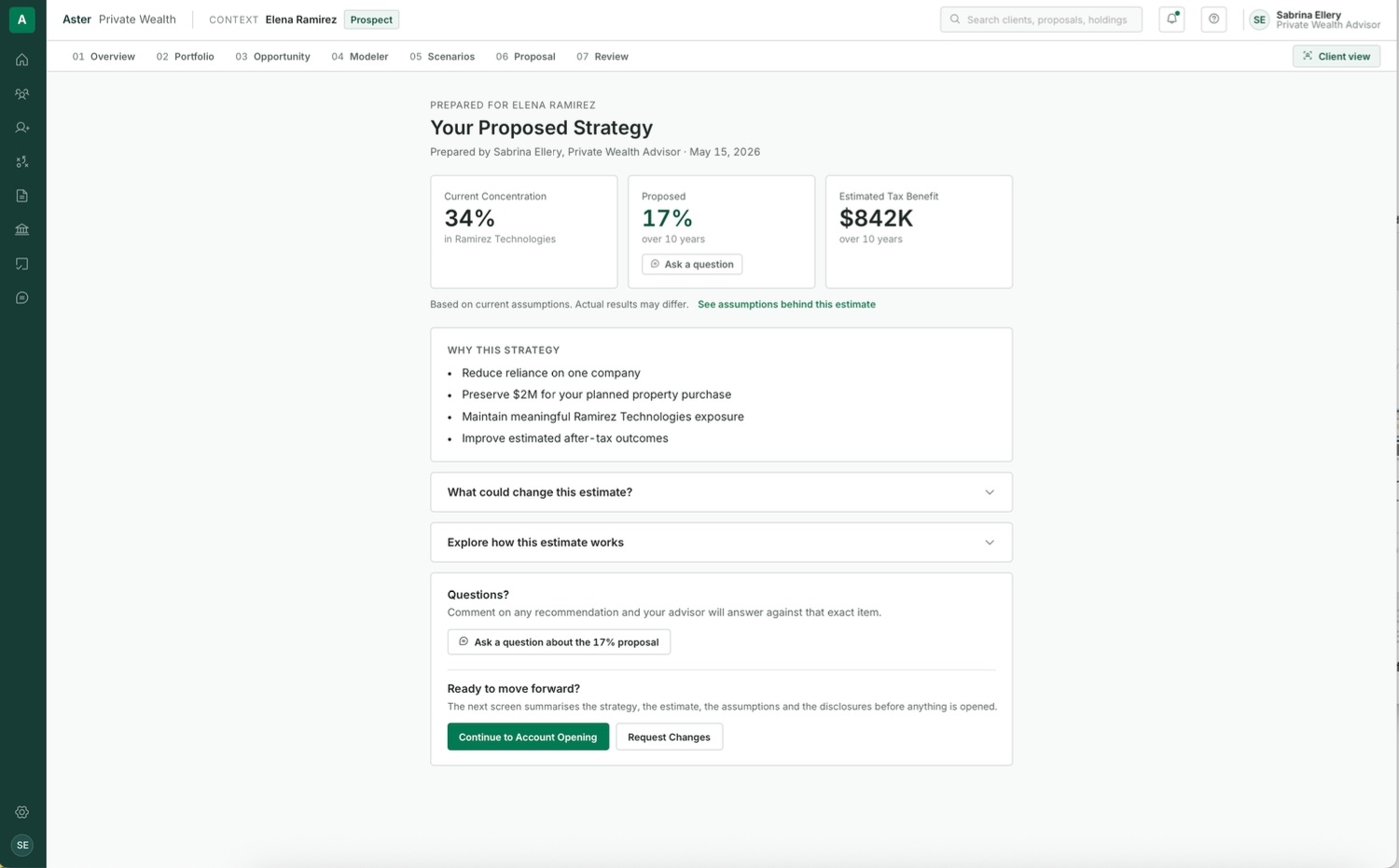
Client view
Client view
Client view: 34 percent current concentration, 17 percent proposed, an estimated 842 thousand dollar tax benefit, why this strategy, and options to ask a question or continue
The first layer is the proposed change, the estimated benefit, the reasons behind it, and a way to ask a question.
I did not remove the complexity.
I changed when it appears.

The deeper assumptions are still there if the client wants to open them. "See assumptions behind this estimate" and "What could change this estimate?" both expand in place.

From adjacent finance interviews

The people I spoke with described spending real time turning finished analysis into presentation material. That convinced me to build the explanation into the workflow instead of leaving it as a separate document, so Prepare Client Proposal, the draft, advisor review, and the client preview all sit on one screen.

AI helps translate, not recommend.

Draft client explanation
Advisor review required
Your portfolio currently holds about a third of its value in one company. This strategy would reduce that to roughly 17% over ten years, keep $2M available for your planned needs, and is estimated to improve your after tax outcome by $842K. This is an estimate based on the assumptions listed below, not a guaranteed result.
Sources usedPortfolio allocationLiquidity goalClient concentration preferenceStrategy assumptions

I was comfortable using AI to draft a client friendly explanation from information already approved in the proposal. I was not comfortable letting it choose the strategy or make the recommendation.

The draft shows the information it used, and the advisor can edit, accept, or discard it before anything reaches Elena.

07 · From decision to action

The workflow should not reset once the client says yes.

Advisor review→Client decision→Account opening
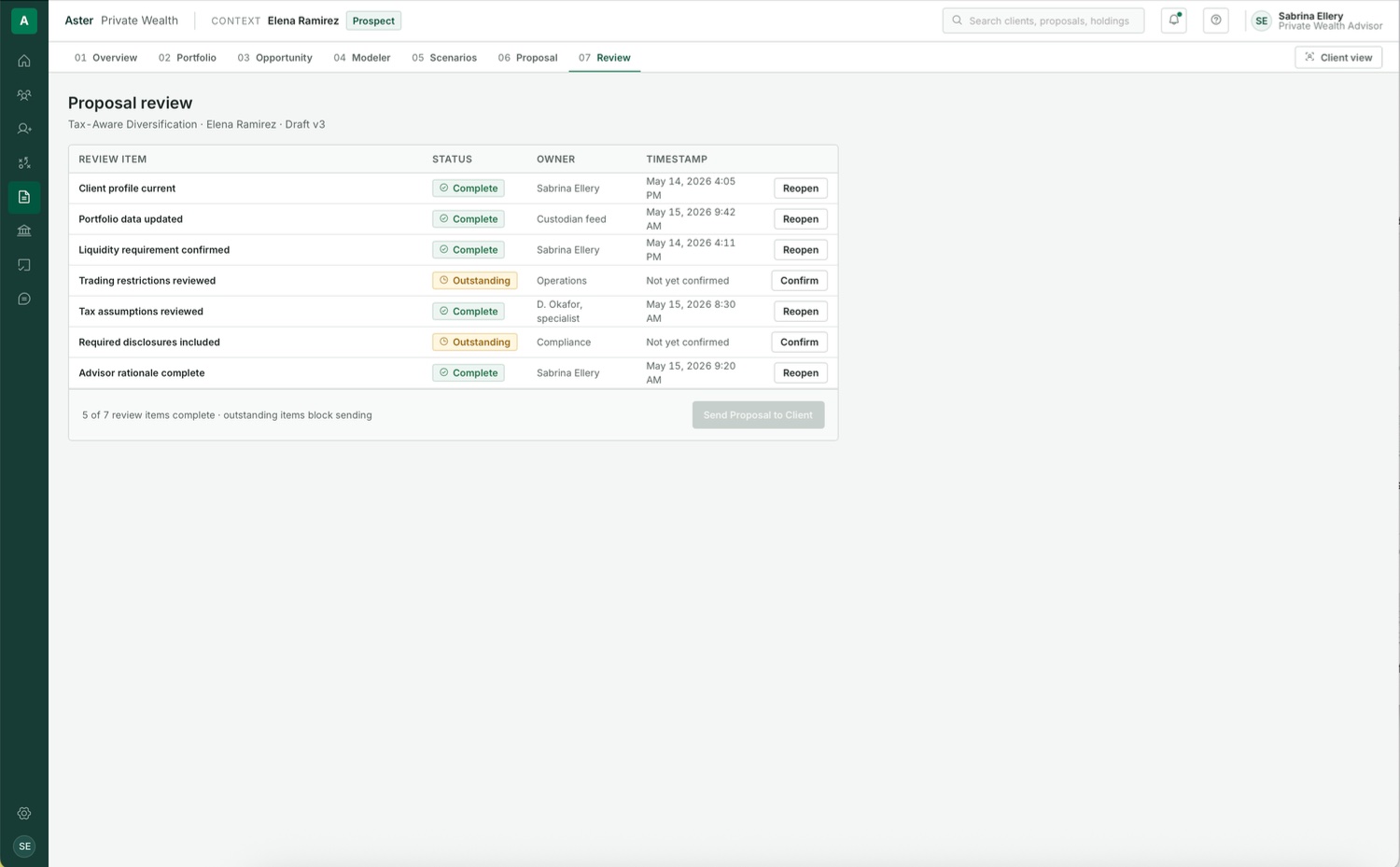
Advisor review
07 Review
Proposal review: seven review items with status, owner and timestamp, two outstanding, and a disabled send proposal to client button
Each check carries an owner and a timestamp.
Client decision
Client view
Client decision screen with the strategy, estimate, assumptions, ask a question, request changes and continue to account opening
The client layer of the same approved proposal.
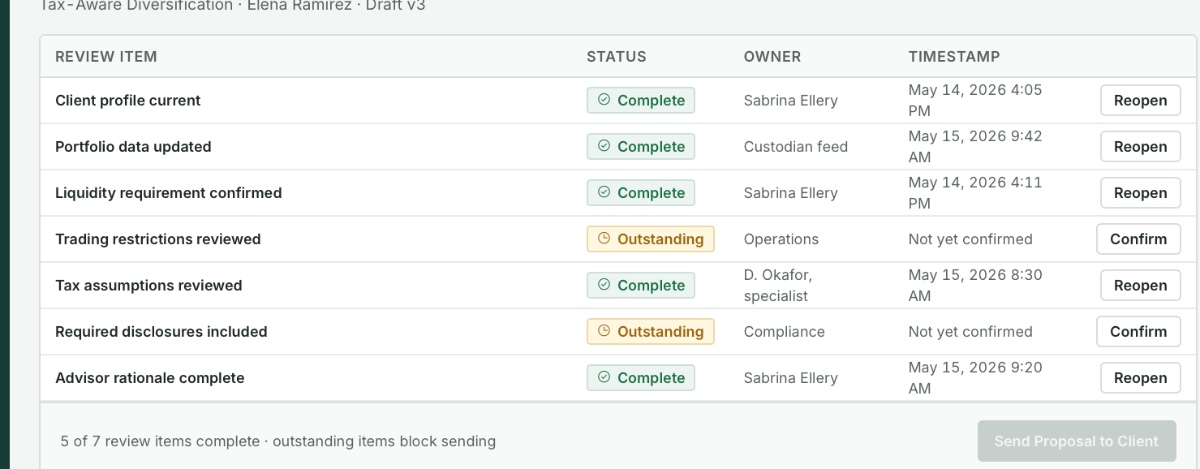
Detail: two outstanding review items owned by Operations and Compliance, with the send button disabled
Five of seven items complete, and sending stays disabled until Operations and Compliance confirm.

I wanted the product to show what still had to happen before a recommendation could move forward. The Review screen lists each check with an owner and a timestamp, so the advisor can see that Operations has not confirmed trading restrictions and Compliance has not cleared disclosures.

Sending is blocked until both are done, and the footer says why: five of seven items complete.

Once review clears, Elena sees the same recommendation in the simpler layout, where she can open the assumptions, ask a question, request changes, or move ahead. The primary action reads Continue to Account Opening rather than buy or execute, because she is agreeing to a strategy, not placing a trade.

Carried forward from approved proposal
Client
Elena Ramirez
Strategy
Tax aware diversification
Expected funding
$18.4M
Liquidity requirement
$2M within 18 months
Risk profile
Moderately aggressive

If Elena continues, the funding amount, liquidity requirement, and risk profile established during prospecting carry into account opening instead of being entered again.

08 · The rest of the product

Designed as a connected advisor workspace.

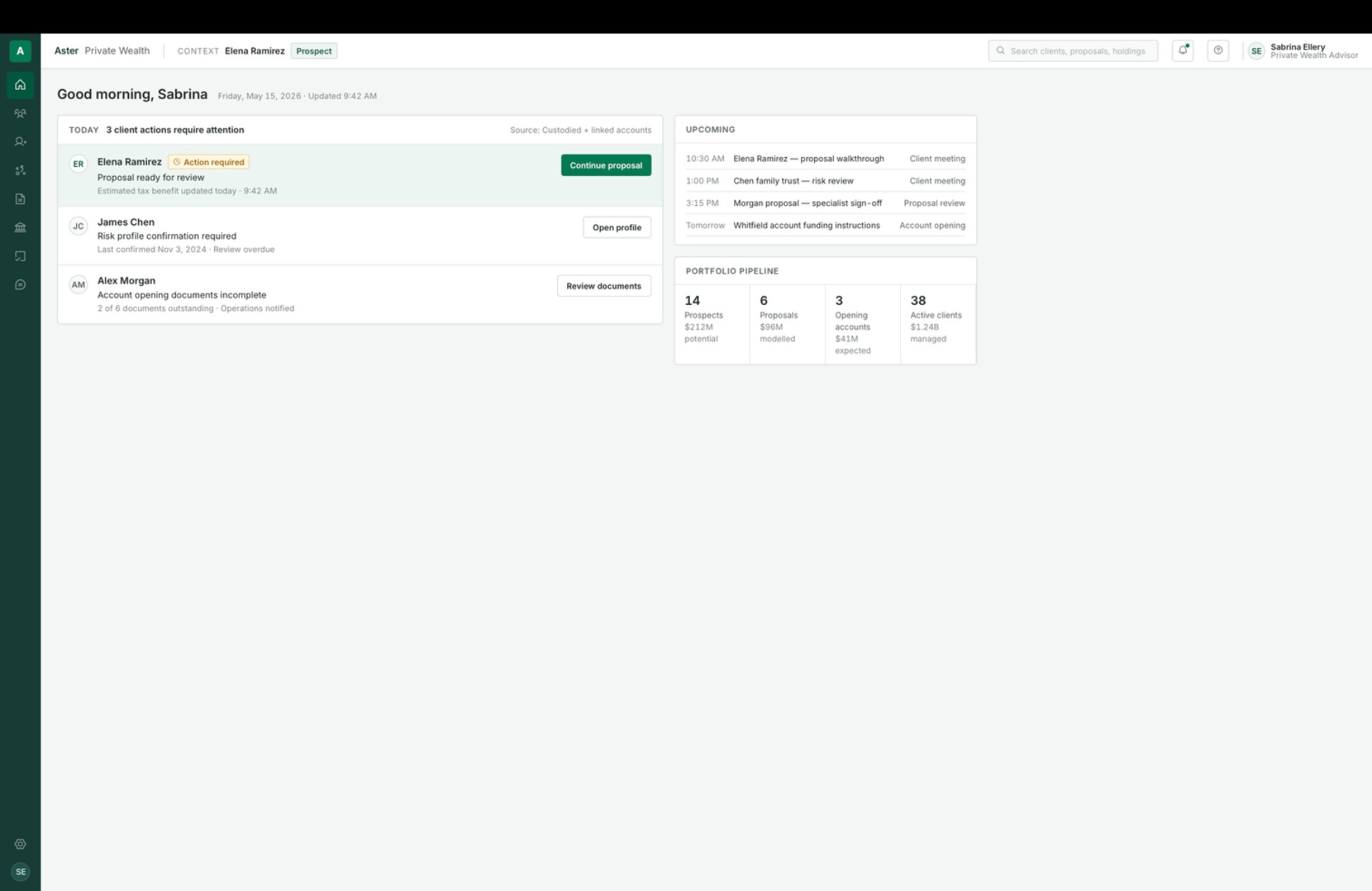
Aster advisor home with today's client actions, upcoming meetings, and portfolio pipeline
Home, clients, tasks, and messages surround the core workflow.

I designed a lightweight workspace around the core flow so the concept felt like a real product rather than an isolated feature. Home, clients, tasks, and messages all connect back to the same client and recommendation.

09 · Design system

Designing trust into the system language.

Estimate
Estimate
Projected value
+$1.1M
Locked assumption
37% federal Locked
Advisor editable
6.5% Editable
Data source
Custodian feed
Timestamp
9:42 AM
Constraint warning
Below floor
Review status
Outstanding
Carried forward
From proposal

I kept the visual system restrained because the financial information is already dense. Status labels, sources, timestamps, tabular numbers, and editable versus locked states do more work here than any decorative treatment would.

10 · What I would validate next

What I would test next.

01

Can advisors understand why an estimate changed without inspecting the underlying calculation?

02

Can clients correctly distinguish an estimated outcome from a guaranteed one?

03

Does Client View remove enough complexity to improve comprehension without removing the information required for trust?

Potential participants
Private wealth advisorsFinancial plannersInvestment professionalsClients who have worked with wealth advisors

This is still a concept, so these are the questions I would prioritize in usability testing.

11 · Closing
Where the project ended up.

Aster started with me trying to understand wealth management for my mother. By the end of the project the question had become much more specific: how much financial detail does an advisor need to make a recommendation, and how much does a client need in order to understand it?

That distinction shaped the Modeler, the scenario comparison, the proposal workflow, and the Client View. If I kept going, that is the part I would want to put in front of real advisors and clients.
Built
Nine stage advisor flow, a scenario modeler, a proposal builder, and a client facing view
Designed around
Assumptions, sources, review ownership, and blocking states
Left to do
Testing the three questions above with advisors and clients
Client view
The client decision screen, the final state of the Aster workflow
Where the workflow lands: one screen the client can read, act on, or ask about.
Next case
Menstrual Tracking Privacy
Open case file